Part 3 of a Series on Communication Expectations by Mary DeSimone, Founder of Mountaintop Education

In the first article of this series, we explored how communication expectations are often embedded within CTE tasks but remain invisible. In the second, we looked at what changes when we make those expectations visible as we plan instruction.
Seeing the expectations is the first step.
Planning for them is the second.
But students also need opportunities to rehearse them.
Students don’t become better communicators by simply hearing professional language. They become better communicators when instruction gives them repeated opportunities to use it.
Mary DeSimone
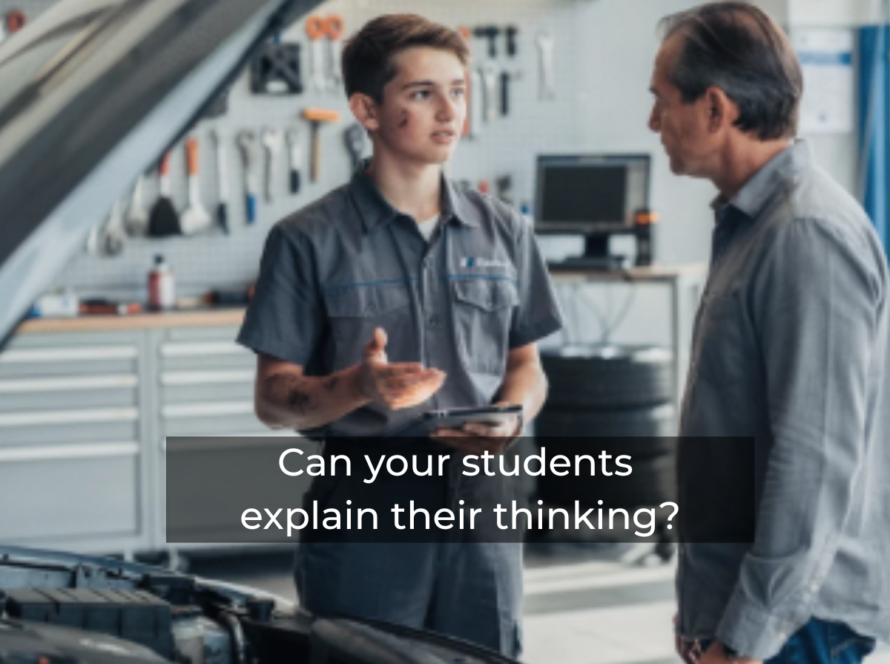
Consider two automotive students completing the same troubleshooting task.
Both correctly diagnose the problem. Both complete the repair. Both restore the vehicle to proper working order.
From a technical performance standpoint, both students have demonstrated success.
Now imagine the instructor asks each student:
“Walk me through your thinking.”
One student explains the symptoms they noticed, describes the tests they performed, identifies the evidence that led to the diagnosis, and explains why they ruled out another possible cause.
The other says:
“I checked the sensor, replaced it, and it worked.”
The second student hasn’t given an incorrect answer. In fact, both students successfully completed the same technical task.
But we can hear something different in their responses.
One response tells us what the student did. The other makes the student’s reasoning visible.
That distinction matters.
From Checking for Completion to Eliciting Reasoning
CTE instructors naturally ask questions that help them monitor students’ work:
Did you finish?
What did you do?
Did it work?
What’s your answer?
These are useful questions. They help us check progress and technical performance.
But they don’t necessarily reveal the reasoning behind that performance.
Consider what happens when we follow them with questions such as:
-
-
- Walk me through your thinking.
-
-
-
- What evidence led you to that conclusion?
-
-
-
- What made you choose that approach?
-
-
-
- What other possibilities did you consider or rule out?
-
-
-
- How do you know the solution worked?
-
-
-
- How would you explain your decision to someone else?
-
Now students have to do more than report what happened. They have to explain, justify, use evidence, and communicate their decision-making.
These are different purposes for communication, and they are embedded throughout technical and professional work.
Purposeful Questions Create Purposeful Rehearsal
The questions we ask don’t just help us find out what students know. They also create opportunities for students to practice communicating what they know.
That matters because professional communication is not something students automatically develop simply by becoming more technically proficient.
A student may learn to complete a procedure before being able to explain the reasoning behind it. A student may understand why a decision makes sense but still need practice communicating that decision clearly to someone else.
And the audience matters.
An automotive student may explain a diagnosis differently to a lead technician than to a customer. A health sciences student may communicate differently with a patient than with a supervising nurse. A culinary student may explain a decision differently to a chef than to a guest.
The technical knowledge remains important. What changes is how students communicate that knowledge for a particular purpose and audience.
This is where purposeful rehearsal becomes important.
Every time students explain their thinking, justify a decision, discuss evidence, troubleshoot with a peer, or adapt an explanation for an audience, they are rehearsing communication they may eventually need in a workplace.
Purposeful questions create purposeful rehearsal.
And that rehearsal doesn’t require a separate communication unit or an overhaul of the technical curriculum.
Sometimes it starts with changing what happens after a student says:
“I’m done.”
Instead of stopping there, we ask:
“Walk me through your thinking.”
Try This Tomorrow
Choose one performance task your students already complete.
You don’t need to change the task.
Instead, identify one question you can ask that moves beyond checking for completion and elicits students’ reasoning.
Then listen.
Are students primarily telling you what they did?
Or can they explain why they did it, what evidence informed the decision, and how they know it worked?
You may discover communication expectations that have been present in the task all along but haven’t yet been given enough opportunities for rehearsal.
To help you get started, I’ve created Questions That Elicit Professional Reasoning in CTE, a collection of prompts organized around different communication purposes, including explaining thinking, justifying decisions, troubleshooting, and adapting explanations for different audiences.
[Download Questions That Elicit Professional Reasoning in CTE]
Professional communication doesn’t develop by accident. When we intentionally create opportunities for students to explain, justify, and communicate their thinking, we help make another part of technical expertise visible.
Mary DeSimone
Founder, Mountaintop Education Consulting
Supporting schools in strengthening instructional clarity through a multilingual lens.